
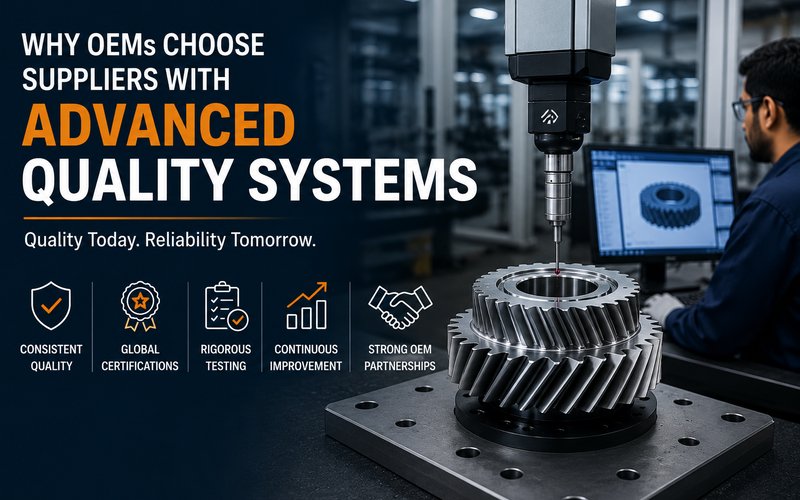
In today's competitive manufacturing environment, Original Equipment Manufacturers (OEMs) face increasing pressure to deliver reliable, high-performance products while maintaining cost efficiency and meeting customer expectations. As a result, choosing the right manufacturing partner has become more important than ever.
For OEMs, a supplier is not simply a vendor—it is a strategic partner that directly influences product quality, production timelines, customer satisfaction, and brand reputation. This is why manufacturers with advanced quality systems are often the preferred choice for leading OEMs worldwide.
The Cost of Poor Quality
Quality issues can have significant consequences throughout the supply chain. A single defective component can impact an entire production line, resulting in delays, increased costs, and reputational damage.
Common risks associated with poor quality include:
- Production downtime
- Product recalls
- Increased warranty claims
- Customer dissatisfaction
- Supply chain disruptions
- Higher operational costs
To minimize these risks, OEMs prioritize suppliers that demonstrate strong quality management practices and a commitment to continuous improvement.
What Makes a Quality-Focused Supplier?
A quality-focused manufacturing partner implements systems and processes designed to ensure consistency, reliability, and compliance throughout production.
Key characteristics include:
- Well-defined quality management systems
- Process standardization
- Advanced inspection methods
- Skilled workforce
- Continuous training programs
- Data-driven decision making
- Strong documentation and traceability
These elements work together to reduce variability and ensure products consistently meet customer specifications.
The Importance of Industry Certifications
Certifications provide OEMs with confidence that a supplier follows internationally recognized quality standards.
Some of the most important certifications in manufacturing include:
IATF 16949
Widely recognized in the automotive industry, this certification focuses on defect prevention, risk reduction, and continuous improvement throughout the manufacturing process.
ISO 9001
This quality management standard helps organizations improve efficiency, customer satisfaction, and process consistency.
ISO 14001
This certification demonstrates a commitment to environmental management and sustainable manufacturing practices.
ISO 45001
Focused on workplace health and safety, this certification ensures organizations maintain safe and efficient working environments.
These certifications help manufacturers establish credibility and build trust with global OEM customers.
Advanced Inspection and Quality Control
Modern manufacturing relies heavily on inspection and testing technologies to maintain product quality.
Advanced quality control processes often include:
- Coordinate Measuring Machines (CMM)
- Gear inspection systems
- Surface roughness testing
- Dimensional verification
- Material testing
- Process capability analysis
These technologies allow manufacturers to identify potential issues before products reach customers.
Moving Toward Zero-Defect Manufacturing
Today's OEMs increasingly expect suppliers to adopt a zero-defect mindset.
While perfection may be difficult to achieve, manufacturers can significantly reduce defects through:
- Statistical Process Control (SPC)
- Root Cause Analysis (RCA)
- Failure Mode and Effects Analysis (FMEA)
- Poka-Yoke error-proofing systems
- Preventive maintenance programs
- Continuous improvement initiatives
These methodologies help organizations improve consistency and reduce production risks.
The Role of Digital Manufacturing
Industry 4.0 technologies are transforming quality management across manufacturing sectors.
Digital manufacturing solutions provide:
- Real-time production monitoring
- Automated quality reporting
- Predictive maintenance capabilities
- Process optimization insights
- Enhanced traceability
With better visibility into operations, manufacturers can respond quickly to potential quality issues and improve overall efficiency.
Building Long-Term OEM Partnerships
Successful OEM-supplier relationships are built on trust, reliability, and performance. Quality-focused suppliers consistently deliver products that meet expectations while supporting innovation and business growth.
OEMs value suppliers that offer:
- Consistent product quality
- On-time delivery
- Technical expertise
- Manufacturing flexibility
- Continuous improvement
- Transparent communication
These qualities help create long-term partnerships that benefit both organizations.
Quality as a Competitive Advantage
In modern manufacturing, quality is no longer just a requirement—it is a competitive advantage. Companies that invest in advanced quality systems can reduce costs, improve customer satisfaction, and strengthen their position in the global marketplace.
For OEMs, partnering with manufacturers that prioritize quality provides confidence that every component will perform as expected, supporting product reliability and long-term business success.
As industries continue to evolve, advanced quality systems will remain one of the most important factors influencing supplier selection and manufacturing excellence.